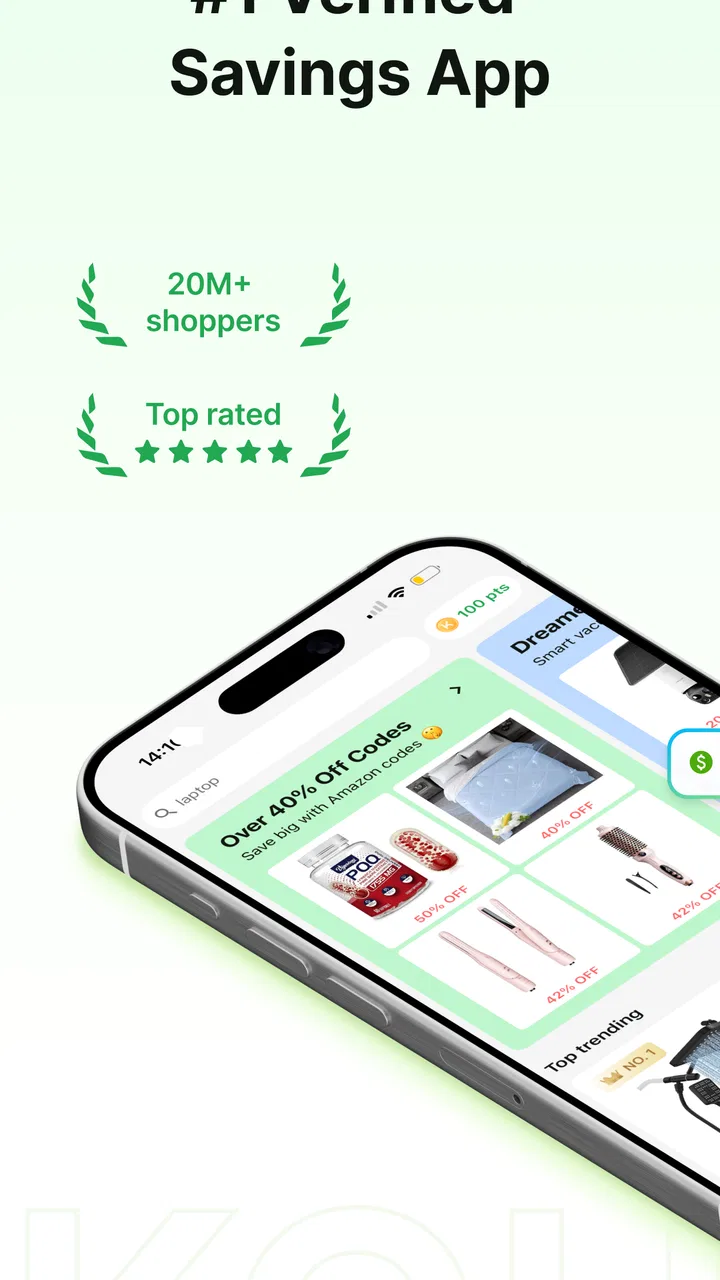
Koupon: Real Deals & Codes
- 4.7
- Rating
- 1.00M
- Installs
- Free
- Price

 Analysis by App-foxy
I approached Koupon: Real Deals & Codes as someone who wants a practical way to check savings before buying, not another shopping app that fills a screen with impressive-looking offers. That distinction matters. Koupon is a free shopping app from Koupon, and its central appeal is straightforward: it focuses on real savings rather than padded promotions or questionable codes. In my experience, that makes it most useful as a quick checkpoint before checkout.
The first thing to understand is what kind of tool this is. It is not a replacement for every retailer’s own app, and I would not treat it as a complete shopping planner. I see it more as a companion for the moment when I already know what I want to buy and want to check whether a better deal is available. That narrow purpose is also its strength. Instead of encouraging me to browse endlessly, it gives me a reason to pause and verify the purchase.
From installation to a useful saving
The app has a 4.7 average from around 3.9 thousand ratings, with over 100 thousand installs. Those figures suggest that the basic idea is resonating with shoppers, but they do not remove the need to use it thoughtfully. A coupon app is only valuable when the saving applies to the exact product, retailer, timing, and checkout conditions I face. I still read the details rather than assuming that every displayed offer will work in every situation.
You May Also Like

 Blood Strike: 2.5 Anniversary
Blood Strike’s Loadouts Turn Every Drop Into a Tactical Gamble
A close look at Blood Strike’s custom loadouts: how fast access to signature weapons reshapes its battle royale rhythm, rewards preparation, and narrows the gap between fights.

 Pandora - Music & Podcasts
Pandora’s Music Is Easy to Start, but Harder to Recover
Pandora’s strength is its low-effort path from a seed to a station. Its weak spot is how much confidence it asks you to place in connection, setup, and quiet recovery.

 8 Ball Pool
 Is Built on Rivalries, Rematches, and Routine
A close look at the rivalries, rematches, shared routines, and unanswered safety questions that turn a quick pool match into a persistent mobile community.

 Samsung Music
’s Quiet Strength Is Playing What You Already Own
Its reach comes less from spectacle than from dependable access to a personal library. That simplicity is both the app’s strongest retention engine and its ceiling.

 AccuWeather: Weather Radar
AccuWeather Review: A Quick, Clear Forecast for Everyday Decisions
For everyday plans, the best forecast is the one you can understand quickly. AccuWeather makes rain timing, radar, and local conditions easy to act on, with a few trade-offs.

 Hill Climb Racing
Why Hill Climb Racing Still Turns Crashes Into One More Run
A tiny car, a bumpy hill and one more upgrade: Hill Climb Racing keeps resurfacing because its simple chaos makes every near-miss feel personal.
More From Our News Desk
View All News


Koupon is free, carries a Teen content rating, and runs on Android starting with version 6.0. Its current version is 2.12.3, so users on older but compatible devices may still be able to try it without needing a recent phone. I appreciate that the entry barrier is low: there is no purchase decision before I can find out whether the app fits my shopping habits.
After installing, I would begin with a specific shopping goal instead of opening the app with no plan. For example, if I am about to order household supplies, I would keep the product name and retailer in mind while checking available deals. This approach makes the first session more useful because I have a clear standard for success: finding a valid saving that applies to something I was already going to buy.
The app’s store summary presents it as a verified real savings service, with no fake promotional codes and no inflated deals. I interpret that as an important promise about its approach, not as a reason to stop checking the conditions of an offer. Even a genuine deal can have restrictions, such as a minimum order, a particular product variation, or a limited checkout path. The practical habit is simple: treat the offer as a lead, then confirm the final price before paying.
Making the first session less frustrating
My recommended first move is to search for one item or one retailer that is already part of your shopping routine. A vague search for “best deals” can produce too many possibilities and make it difficult to judge whether the app is helping. A focused search gives you a direct comparison between the normal purchase and the purchase after applying the available offer.
When I find a promising result, I would read the wording carefully before switching away. I would look for the action the offer expects, whether it applies to a product or a broader order, and whether the saving is automatic or requires a code. This is one of the most important workflows in a coupon app: do not rely on the headline alone, because the useful information is usually in the conditions surrounding it.
I would also keep the retailer’s checkout open in a separate step if my phone makes switching between apps easy. That lets me compare the offer with the actual cart instead of trying to remember details. If the app provides a code, I would copy it carefully and paste it into the retailer’s designated field. If the offer redirects me to a store, I would confirm that the retailer and product match what I intended to buy before completing the order.
The first meaningful success is not simply opening a deal. It is reaching a final cart where the saving is visible and the purchase still makes sense. A small discount on an unwanted product is not a win. I find the app more valuable when it helps me reduce the cost of a planned purchase without changing my decision just because a promotion appeared.
A realistic everyday example
Imagine that I am preparing a weekly household order and already need a few repeat items. Before checkout, I would open Koupon and check the retailer or product category rather than searching randomly. If I find a relevant offer, I would compare its conditions with the contents of my cart. A minimum-spend requirement might be worthwhile if the items were already needed, but it would be a poor reason to add unnecessary products.
Next, I would apply the offer exactly as instructed and return to the cart. I would check whether the discount appears before entering payment information. If it does not, I would not assume that the saving will be added later. I would revisit the offer instructions, check the product selection, and decide whether the purchase remains worthwhile without the promotion. This habit protects against a common mistake: treating a possible saving as guaranteed money already earned.
This example also shows where Koupon can save time. I do not need to visit several unrelated coupon pages and test a long list of random codes. The app’s stated focus on real deals is useful when it narrows the search to offers that are intended to be credible. The trade-off is that I still need to make the final verification myself, especially when the order includes several products or variations.
What can be confusing at first
The word “verified” can create an expectation that every offer will work automatically. I would set a more realistic expectation: verification should make the search more trustworthy, but it cannot guarantee that every retailer, cart, account, or product combination will behave identically. Retail checkout systems change, promotions expire, and some offers depend on details that are easy to overlook.
Another possible confusion is the difference between a deal and a code. A deal may lead me to a reduced price or a promotional page, while a code may require an extra step at checkout. I would not treat those formats as interchangeable. If the app shows instructions, I would follow them in order instead of copying a code into a random search box or assuming that opening a retailer is enough.
It is also easy to confuse a discount with the lowest total cost. Delivery charges, taxes, minimum-order rules, or a higher base price can change the final result. Koupon helps me locate a saving, but I still compare the complete amount I will pay. In some cases, a retailer’s own sale or a familiar loyalty benefit may be better than the coupon found in a separate app.
For that reason, I would avoid stacking several promotions blindly. If one offer is already applied, adding another may make the checkout reject the code, remove the first discount, or produce no additional benefit. The sensible approach is to test the simplest valid option first, then compare the final total rather than collecting codes for their own sake.
Where it fits beside ordinary alternatives
Without a dedicated coupon app, I might search the web, browse a retailer’s promotion page, rely on email offers, or open the store’s own shopping application. Those methods can work, particularly when I shop at one retailer repeatedly. The advantage of Koupon is convenience: it gives me a focused place to check for savings before I commit to the order.
Retailer apps are usually better for account-specific benefits, order history, delivery tracking, and loyalty features tied directly to that store. I would choose the retailer’s app when I already know that my membership or personal promotion is the main source of savings. Koupon becomes more useful when I want a broader check or when I am comparing purchases across different shopping destinations.
General web searches can expose a larger range of results, but they also require more judgment. Old pages, copied codes, and exaggerated discounts can waste time. Koupon’s emphasis on genuine offers is appealing because it aims to reduce that noise. Still, I would not abandon common sense: the final retailer checkout remains the authority on whether the offer actually applies to my order.
Browser-based coupon tools may be more convenient for people who shop mainly on a computer, especially when they can detect offers during checkout. Koupon is a better fit for someone who makes purchases on a phone and wants to check deals deliberately before opening or finishing a retailer order. Neither approach is automatically superior; the better choice depends on where I shop and how much control I want over the final decision.
Three habits that make the app more useful
First, I would search before building the cart, but I would confirm the offer again after selecting the exact product. This two-stage check avoids a subtle problem: an offer may look suitable for a general item while excluding a particular size, brand, color, or bundle. The extra moment is worthwhile when the order is expensive or includes several substitutions.
Second, I would record the original total mentally or in a note before applying the promotion. That gives me a clean comparison and prevents a percentage-looking discount from distracting me from the actual amount saved. The important question is not whether the offer sounds large; it is whether the final total is lower than the best realistic alternative.
Third, I would use Koupon as a decision filter, not as a shopping trigger. If an offer encourages me to buy something I did not need, the app has worked against my budget even if the item is discounted. This is especially important with minimum-spend promotions. The saving is meaningful only when the extra spending would have happened anyway or when the complete order remains justified.
A fourth useful habit is to keep the app in the routine for larger or less frequent purchases rather than checking it obsessively for every small item. For a tiny purchase, the time spent comparing options may outweigh the saving. For a planned order with several products, a careful check can have more practical value. This is where the app feels most balanced: it supports good shopping decisions instead of promising effortless savings in every situation.
Who should use it, and who should skip it
I would recommend Koupon to shoppers who often pause before checkout, compare prices across retailers, and want a dedicated place to look for credible promotions. It is particularly suitable for someone who dislikes testing suspicious codes and prefers a shorter, more focused search. New coupon users may also appreciate its clear purpose because they can begin with one planned purchase rather than learning a complicated rewards system.
I would be more cautious about recommending it to someone who expects every saving to be automatic or who never checks purchase conditions. The app cannot replace attention at checkout. It may also be less useful for a shopper whose savings already come almost entirely from a single retailer’s loyalty program, personalized offers, or subscription benefits. In that situation, the store’s own tools may provide more relevant information.
People who shop impulsively should also be aware of the psychological trade-off. Seeing a deal can make an unnecessary purchase feel responsible. I would use the app only after deciding what I need, not as a source of ideas for spending. That simple boundary makes the service more helpful and keeps the discount from becoming an excuse.
My overall take after using it
Koupon succeeds because it keeps the central task easy to understand: check whether a real saving is available before buying. Its free access, broad Android compatibility, and focus on authentic deals make it approachable for first-time users. I like it best as a final pre-check, when I have already chosen a product and want one more chance to lower the total.
It is not a substitute for comparing the complete checkout price, reading conditions, or knowing when a retailer’s own promotion is better. Those limits are not reasons to dismiss it; they define how to use it responsibly. The app gives me a more focused starting point than a random web search, but I remain responsible for confirming the result.
My advice is to install it with one real purchase in mind, search for that retailer or item, follow the offer instructions carefully, and judge success by the final amount rather than the promotional wording. If that process saves money without adding unnecessary shopping, Koupon has earned a place in my routine. Use it as a verification step, not a reason to spend.
FAQs for Koupon: Real Deals & Codes
01What is Koupon: Real Deals & Codes?
Koupon: Real Deals & Codes is a mobile application designed to provide users with access to exclusive deals, discounts, and promo codes for a wide range of products and services. It aggregates offers from various retailers, ensuring you save money on your purchases. Available for both Android and iOS, it is a must-have for savvy shoppers.
02How does Koupon ensure the deals are up-to-date and valid?
Koupon employs a dedicated team and sophisticated algorithms to continuously update and verify the deals and promo codes available on the platform. This ensures that users always have access to the latest and most reliable discounts, minimizing the risk of encountering expired or invalid offers.
03Is Koupon free to use, or are there any hidden fees?
Koupon is completely free to download and use. There are no hidden fees or subscription costs involved. The app aims to provide a seamless and cost-effective experience for users, allowing them to enjoy savings without any financial commitments.
04Does Koupon require access to personal information?
Koupon requires minimal personal information to function effectively. Users may need to create an account to personalize their experience and receive targeted offers. The app takes privacy seriously, implementing robust security measures to ensure personal data is protected and used responsibly.
05Can Koupon be used internationally, or is it region-specific?
Koupon is primarily focused on deals and offers available in specific regions, mainly targeting the U.S. market. However, it is expanding its reach to include international deals. Users outside the U.S. should check the app’s availability and the regional applicability of the deals before proceeding.
Pros
- User-friendly interface for easy navigation.
- Extensive database of deals and coupons.
- Regular updates with new discounts.
- Customizable notifications for favorite stores.
- No account required for browsing deals.
Cons
- Occasional expired coupons still visible.
- Requires internet for full functionality.
- Ads can be slightly intrusive at times.
- Limited support for international stores.
- Some deals may have hidden terms.

Koupon: Real Deals & Codes
Gallery